If you have ever booked a rug clean and thought, “Surely it is just washing and drying,” you are not alone. But rugs are not like fitted carpet, and they are not like laundry either. A rug is a layered textile with a foundation, backing, fringe, dyes, and finishes, and once moisture gets into those layers, it behaves differently.
You might want it back fast, but fast is not the same as safe. We quote a 3 to 4 week turnaround.
At our rug cleaning facility in Cambridgeshire, drying is treated as a technical stage, not an afterthought. That window gives us room to clean thoroughly, dry properly throughout the whole structure…
Key takeaways
- Drying time is not the same as turnaround time, because touch dry does not mean fully dry through the structure.
- Most post-clean issues start with moisture… so, drying is treated as a technical stage, not an afterthought.
- The rug decides the timeline, because fibre, construction, thickness and season all affect the drying process.
- A 3 – 4 week turnaround protects quality, allowing inspection, rug-appropriate cleaning, controlled drying, finishing and re-checking…. yes, we reclean if we don’t feel the first clean was enough.
- If a rug needs longer, it is usually for safety, not delay, especially with dye sensitivity, odour work, or heavier foundations.
What “rug drying times” really means, and why we quote 3 to 4 weeks
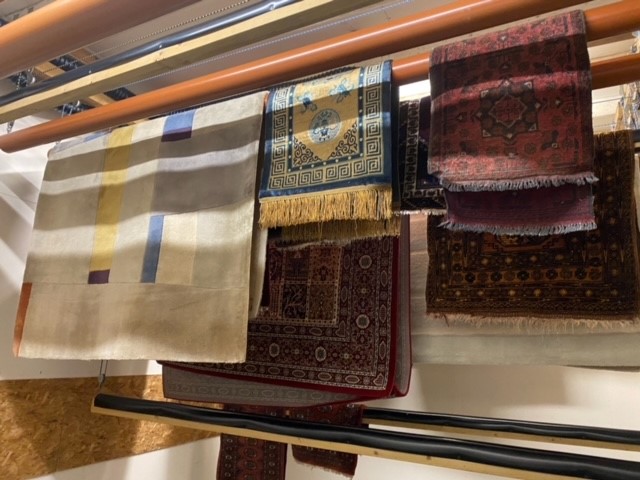 Most people ask about drying time because they are really asking, “When can I put it back down?” That is fair. The problem is that there are two different versions of dry, and one of them is misleading.
A rug can be touch-dry on the surface and still be damp underneath. Moisture can sit in the deep pile, the foundation, the backing, and the fringe long after the top feels fine. That hidden dampness is where the headaches start, because it is the part that can hold odour, stress the shape, and dry unevenly.
When we talk about drying time, we mean fully dry through the entire rug, not just “it feels alright if I brush my hand over it”.
This is also why we separate “drying time” from “turnaround time”, because the safe finish line is not the same as the first moment it stops feeling wet.
Why We Don’t Rush Rug Drying Times After Professional Cleaning
It is tempting to think quicker is always better, especially if your rug anchors the room. But with rugs, rushing can create problems that are harder to undo than the original dirt.
Proper extraction and controlled drying are not optional, they are the protective part of the service.
Browning and yellowing are often drying issues, not missed cleaning. Many rugs include plant-based fibres in the foundation and fringe, and if those areas dry too slowly you can sometimes see discolouration develop as moisture moves and dries unevenly. It is frustrating because it can look like the rug has been made worse, when the real issue is that it did not dry in a controlled, even way.
A musty smell is usually trapped moisture. If you have ever left a damp towel in a heap and noticed the smell later, you already understand the principle. A rug that is still damp in the base can develop that same kind of stale odour… proper extraction and controlled drying are not optional, they are the protective part of the service.
Shape and finish can shift when drying is uneven. Some rugs are more prone to edge curl, rippling, or slight distortion after wet cleaning, especially if one area dries faster than another. A controlled environment helps the rug dry consistently, which supports a flatter finish when it returns home.
There is also a wider health reason we take drying seriously. Government guidance on damp and mould focuses on the health impacts of persistent moisture and the importance of addressing damp conditions as soon as possible. We are not suggesting your rug equals a housing hazard, but the principle stands, lingering moisture is the enemy, our workflow is designed so rugs are not left sitting damp while they “hopefully dry out”.
You can see our rug cleaning process in this YouTube Video…
What Affects Rug Drying Times After Professional Cleaning?
People often want a single number, but there is no honest one-size answer because rugs are too varied. What helps more is understanding what changes the clock.
Fibre matters. Wool behaves differently to synthetic fibres, it can hold moisture in a way that still feels “almost dry” on top. Construction matters too. Flatweaves, tufted rugs, hand-knotted rugs, and thick pile rugs all release moisture differently, and some backing materials can hold onto dampness for longer. Size and density matter because a larger, heavier rug simply contains more water after cleaning, even with strong extraction.
Then there is the environment. Temperature, airflow and humidity have a direct impact on evaporation. In winter, higher ambient humidity and lower temperatures can slow drying, which is something we regularly see with rug cleaning work across Cambridge and the surrounding areas.
If you are weighing up whether to refresh a rug yourself or hand it over, the guide on DIY rug cleaning vs professional rug cleaning is a useful sanity check because it covers the risk factors that tend to catch people out.
Why do we quote a 3 to 4 week turnaround?
Proper rug cleaning is a sequence, not a single event. You might be picturing one clean and one dry, but the safest version includes inspection, the correct cleaning approach for that specific rug, controlled drying, finishing, and then calm return scheduling. That is what the 3 to 4 week window protects.
Before anything gets wet, the rug needs inspecting & pre-testing. Soil can hide so many issues, such as prior dye bleeding, worn areas, or colour variations that only become obvious after washing. That is why our rug cleaning service is set up around assessment first, not assumptions.
Next, thorough dry soil removal matters because grit and fine particles settle deep in the base and act like sandpaper over time. If you skip this, you can clean the surface and still leave the abrasive material behind… the rug may look better, but not truly be healthier.
Then there is treatment work, and this is where timelines can stretch in a good way. Some rugs need careful stain work, some need fringe attention, and some need odour work that cannot be rushed. Pet accidents are the classic example. Contamination can travel into layers you cannot see, and a quick surface rinse at home can push it deeper, we point clients towards our guidance on pet urine in your carpet and rugs because it explains why smells often return after “DIY fixes”.
Drying is the next critical stage, but it is not the end. Once the rug is fully dry, it still needs finishing so it will lie well and look right. Plus final checks will be done so you don’t have any unrolling surprises at home. Only then does delivery planning start. If you need to coordinate around guests, a move, or a renovation, booking via the contact page lets us plan properly rather than making rushed promises.
When a rug may need longer than 3 to 4 weeks
Sometimes your rug will be ready sooner. Sometimes it needs longer, and when it does, it is usually because slowing down protects the rug rather than delaying it for no reason.
Thicker rugs and heavy foundations can hold moisture for longer. Dye-sensitive rugs can need a gentler pace and extra checking. Odour work, particularly where there has been pet contamination, can require deeper flushing and verification so odours do not return once the rug warms up in a lived-in room. Fringe and edge finishing can also add time because those areas often need more careful handling to look clean and even.
Extra time is not “being slow”. It is choosing safety over regret… we would rather be honest about the timeline than return something quickly that creates a second problem.
The reassurance, what you are really paying for with the timeline
Being without your rug for a few weeks can feel inconvenient, especially if it pulls the room together. But a rug that comes back clean, stable, fully dried, and properly finished is worth far more than a rushed return that creates new problems.
So when we quote 3 to 4 weeks, it is not a delay for the sake of it. It is a protective window that covers inspection, correct cleaning, controlled drying, finishing, and quality checks… You get a result that lasts, not a quick win that unravels. That’s the type of service we offer, and customer care is why we do it! Have a read of our article about “Rug Cleaning in Cambridge and Why It Takes Time”
Many of our Cambridge clients come to us after a previous fast turnaround left them with lingering odours or shape issues. The longer timeline avoids that cycle and delivers a result that actually lasts.
FAQs
How long are the rug drying times after we have professionally cleaned it?
It depends on fibre, construction, thickness, and the drying environment. The surface can feel dry sooner, but full drying can take longer, especially with wool and dense pile rugs.
Why does my rug smell after it gets wet or cleaned?
A damp smell usually means moisture stayed trapped in the base long enough for odour compounds to build. Proper extraction and full drying time prevent that smell from lingering.
Can a rug go mouldy if it stays damp?
Yes, prolonged moisture increases the risk of mould, which is why public guidance on damp and mould focuses on the harm that persistent damp conditions can cause.
Why does rug cleaning take weeks, not days?
Because a proper service includes inspection and testing, deep soil removal, rug-specific treatment, controlled drying, finishing, and final checks, plus sensible collection and return scheduling.